

Running out of custom boxes midseason causes delayed shipments and forces you to scramble for alternatives. On the other hand, overordering can tie up cash in inventory you don’t need yet. Guesswork isn’t a viable option because demands shift and lead times stretch, affecting your bottom line.
Packaging forecasting is a way to eliminate these obstacles. With a strategic approach, you can predict your custom box needs with enough accuracy to avoid stockouts, minimize excess inventory and keep operations running smoothly.
Accurate forecasting may seem abstract at first, but once you understand the mechanics behind it, you’ll appreciate how much strategy it involves. You can make reliable predictions by reviewing your sales patterns, using historical data to anticipate demand and reduce uncertainty.
The goal of inventory forecasting for packaging is to decide what comes next by applying the knowledge you already have. Begin by comparing your sales history against market trends to make intelligent, confident decisions.
First, separate repeat patterns from one-off sales spikes by analyzing one- to two-year sales periods. While you can derive some insights from a single quarter, that won’t tell you as much as a full year or two will. Sticking with a 12- to 24-month sales history reveals the trends that matter.
You can track these data points based on:
This historical view provides the foundation you need to make confident predictions. Without it, you’ll build a forecast on assumptions instead of evidence.
Establishing an accurate starting point is foundational to good custom box inventory management. In other words, you can’t calculate what to order until you know what’s already in stock. Take a comprehensive inventory, subtracting what you have from your projected need to determine the order quantity. It’s a simple, but often overlooked, step.
Every business experiences cyclical highs and lows, which you can anticipate by mapping them. Retailers that account for seasonality and cycles in their forecasting can better avoid careless errors.
Identify which months or quarters consistently drive higher volume. For example, Q4 often accounts for a substantial portion of total annual retail sales, frequently representing most of the year’s total. The period between Nov. 1 and Dec. 31 is the most lucrative for many e-commerce sellers, and historical data consistently confirms this.
Analysis of e-commerce sales data from the U.S. Census Bureau shows that first-quarter sales can be lower than the preceding Q4 figures when not seasonally adjusted. This consistent pattern reinforces Q4 as the structural peak quarter for many businesses.
Your unique value proposition differentiates your business from competitors. Determining your peak windows is essential for forecasting your e-commerce packaging requirements.
Follow these steps to identify your seasonal peaks:
Placing packaging orders at least eight to 12 weeks ahead of each window is an industry best practice for demand planning for packaging materials.
Promotions and product launches create demand spikes that historical data alone can’t predict — and these events can stretch your packaging needs far beyond what past sales suggest. For example, analyzing seasonal norms can’t prepare you for a new product that goes viral on social media overnight.
Sales history is only one part of the equation. Effective forecasting also requires aligning your packaging plan with your marketing calendar. Review the next six months of planned promotions and estimate how many additional boxes each initiative will require. When you combine historical patterns with upcoming demand drivers, your forecast will be far more accurate and strategic.
Custom corrugated boxes aren’t off-the-shelf products. They require structural engineering, materials sourcing, production runs and shipping, which are time-consuming. The months of effort you put into creating the perfect forecast could be for nothing if you haven’t built your supplier’s lead times into your order decisions.
For a custom box inventory management plan that suits your needs, look for providers who have:
Once you know your supplier’s lead time, work backward from your need date to calculate your order deadline. Building these timing windows into your forecast calendar lets you reorder before you run low.
There’s typically a minimum order quantity for custom boxes, which directly affects your forecasting. The MOQ is the smallest amount of a product a supplier is willing to sell in a single order. For example, you may need to maintain higher inventory levels if your forecast calls for 200 boxes but your MOQ is 500. Of course, this could also increase your storage costs.
The upside of calculating an accurate MOQ is that you get access to bulk pricing and more favorable packaging supply chain optimization. Lower per-unit costs can offset storage expenses if you know you’ll use that inventory within a reasonable time frame.
Have you ever noticed that you always seem to run out of stock at the worst possible moment? Building in a buffer protects your business against unexpected spikes or delays. Safety stock can save the day.
A general rule of thumb is to keep two weeks of coverage on hand, or between 10% and 20% of your cycle stock. The exact amount will always depend on the variability in supply and demand for your business.
The 10% to 20% rule of thumb for safety stock is a decent starting point, but you can estimate safety stock numbers more accurately with this simple calculation.
Box sizing and styles may begin as design decisions, but they also shape your forecasting model. Each product relies on a specific packaging format, creating distinct demand curves for every box type and style you use. A broad product mix often requires separate forecasts to keep packaging supply aligned with sales activity.
Avoid ordering errors by tracking what kind and how many boxes you use to fulfill each order. This approach also leads to more accurate storage space planning and shipping cost calculations.
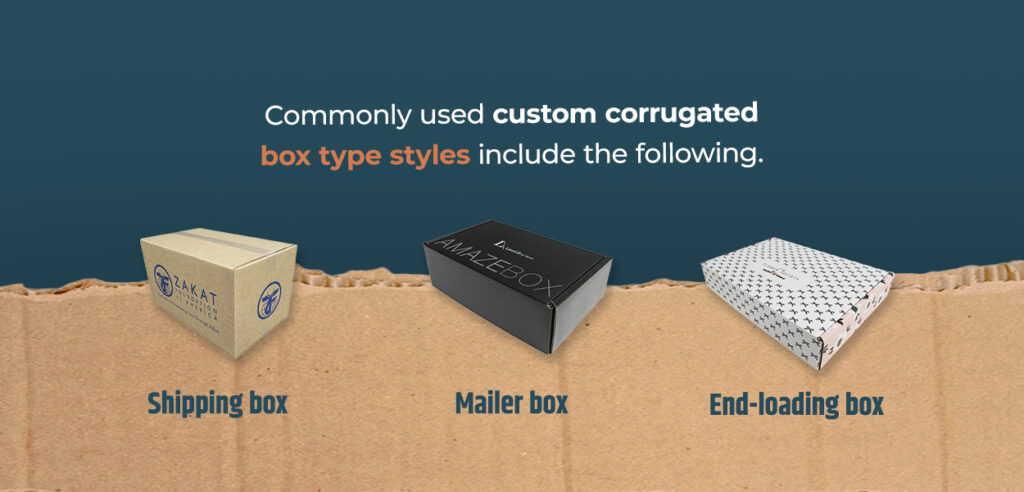
Commonly used custom corrugated box type styles include the following.
While an effective packaging forecasting plan lets you predict your custom box needs, don’t allow your strategies to stagnate. Regularly review your forecast and consider updating it at least once a quarter — more often, if your business experiences predictable seasonal growth cycles.
Effective demand forecasting practices let you refine models using performance data. The following instances should trigger an immediate forecast review:
While your business may concentrate on ways to reduce packaging costs, you should still be aware of potential hurdles. These two potential failure modes are opposite ends of the same problem, and awareness of them reduces your chances of falling into either trap.
Imagine running out of boxes during peak season or before a product launch. Even if your supplier offers quick turnarounds, custom boxes require manufacturing time, so you can’t expect them overnight.
The consequences of this mistake can include delayed shipments, frustrated customers and inconsistent branding due to having to use plain, logo-free boxes. Your reputation will take a hit, leaving you scrambling to cobble together a solution that doesn’t meet your expectations.
On the other side of the spectrum, what if you order too much stock? You now have excess packaging inventory tying up cash flow and occupying valuable warehouse space. While you can reduce waste by choosing sustainable boxes, overstock is still a poor use of resources.
Overstocking often occurs when businesses pad their peak-season forecasts but fail to adjust them back down for slower months. Your forecast should account for the full cycle by ramping up for peaks, then scaling back to baseline once the surge passes.
No matter how detailed and accurate your forecasts are, they won’t optimize your supply chain unless you share this information with your box supplier. When a vendor is familiar with these insights, they can keep your deadlines on track by planning production capacity and securing materials ahead of time.
Communicate with your suppliers:
Partnering with a reputable custom packaging supplier that handles structural design, print, manufacturing and shipping under one roof turns your forecast into a reliable execution plan.

Your packaging predictions are only as good as the supplier that carries them out. Once you complete your strategic forecast, choose Bolt Boxes for reliable execution. We have almost 60 years of experience making customized packaging from our Minneapolis headquarters, including structural design, manufacturing, shipping and digital, flexo and litho print capabilities.
Our production practices are ISO 9001:2015- and G7 master-certified, ensuring consistent quality and precision across every order. If you need boxes fast, we’ve built our process to handle quick turnaround requests without sacrificing quality. Unsure what you need? Request a sample box and evaluate the quality yourself before committing to a full order.
Use our Box Builder for an instant quote on custom boxes to put your plans into action.

