


Packaging waste requirements continue to tighten as regulators demand greater accountability. At the same time, retailers require proof of sustainability commitments before approving suppliers. For businesses navigating these pressures, going green can feel abstract and overwhelming.
It doesn’t have to be. Reducing your packaging carbon footprint starts with a clear, data-driven approach that turns vague sustainability goals into concrete actions that benefit both the environment and your bottom line.
Understanding how to measure packaging emissions is the foundation of any reduction effort. The standard metric is the Product Carbon Footprint (PCF), which quantifies a product’s total greenhouse gas emissions across its life cycle. PCF uses carbon dioxide equivalent (CO2e) as its unit of measurement. It accounts for all greenhouse gases, not just carbon dioxide.
The Greenhouse Gas (GHG) Protocol’s product standard provides the globally recognized framework for calculating PCF. Following this methodology can help you make more credible, comparable measurements. The standardized approach also lets you communicate results to stakeholders using language they recognize and trust.
The process breaks down into four key steps:
Decide where your analysis begins and ends. Two assessment types to consider include:
Most companies start with cradle-to-gate and gradually incorporate downstream data as it becomes available.
Accurate carbon footprint analysis of packaging requires detailed activity data from every stage. The categories below represent the core data points you will need to gather:
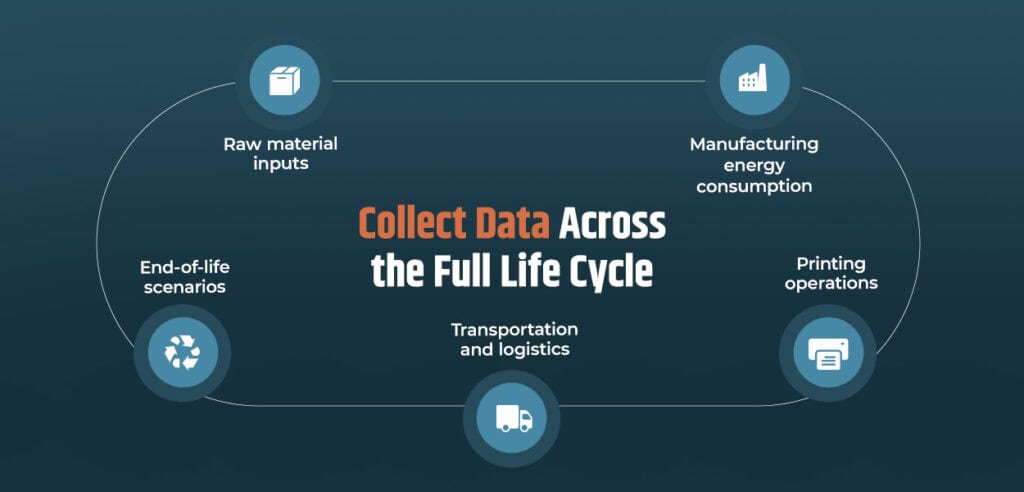
Start with the data you can access easily, then systematically fill gaps over subsequent measurement cycles.
Emission factors are standardized values that convert activity data into estimated emissions. For example, burning 1 gallon of diesel fuel releases a known quantity of CO2e. Government agencies and research institutions publish these databases. The Environmental Protection Agency (EPA) provides recycling and waste information for common packaging materials, typically reporting results in kilograms or metric tons of CO2e per unit.
When selecting emission factors, match them as closely as possible to your actual processes. This precision is especially important when comparing multiple packaging options or tracking improvements over time.
Review your calculations to pinpoint which life cycle stages contribute the most emissions. These high-impact areas reveal where reduction efforts may deliver the most significant results. The dominant stages vary by packaging type, but commonly include:
If virgin plastic accounts for a substantial share of your emissions, switching to recycled alternatives may have a noticeable impact. When transportation ranks among the highest contributors, opting for right-sized packaging can help maximize shipping efficiency and become a valuable strategy. Manufacturing energy is often a key driver of heavy corrugated or molded fiber packaging and may indicate it’s time to consider suppliers with renewable energy commitments.
Document these findings in a simple breakdown showing percentage contribution by life cycle stage. This will become your roadmap for targeted improvement and provides baseline data for tracking progress over time. With this foundation in place, you’re ready to implement the reduction strategies below.
Once you’ve measured your baseline and identified where emissions concentrate, the next step is to reduce them. Most companies find they can implement multiple strategies simultaneously for compounding benefits. The following strategies address the most common emission drivers, offering practical ways to lower your environmental impact. Each approach targets a different aspect of your packaging system, so you can prioritize based on your specific emission hot spots.
Material choice plays a key role in your packaging carbon footprint. Virgin plastics generally carry a higher carbon cost due to petroleum extraction and energy-intensive manufacturing, while recycled materials and renewable alternatives like corrugated cardboard are often considered lower-impact options.
Corrugated boxes with recycled content are often a strong option for reducing emissions while maintaining the protective qualities packaging needs. Recycled fiber production typically uses less energy than manufacturing virgin fiber from trees.
Businesses transitioning to plastic-free shipping often see measurable footprint reductions while meeting customer expectations for sustainable packaging. Prioritize materials with verified post-consumer content and transparent sourcing, and consider fiber-based alternatives for applications that currently use plastics.
Molded pulp, paperboard and corrugated solutions can replace plastic clamshells, blister packs and protective inserts in many use cases. Material switches often represent the single largest opportunity for emissions reduction in your packaging portfolio.
Right-sizing means engineering packaging dimensions to fit products precisely, eliminating excess resources and wasted space. This dimensional optimization allows more units per truck or pallet, directly reducing freight emissions per unit delivered.
The impact compounds across the supply chain. A package reduced from 12×12×8 inches to 10×10×6 inches enables more units per pallet with tighter dimensions. Multiply this across thousands or millions of annual shipments, and the transportation emissions savings become substantial.
Production equipment runs more efficiently when processing custom sizes rather than trimming down standard oversized sheets. Die-cutting is cleaner, forming operations run faster, and quality control improves when dimensions match product geometry precisely.
Minimalist packaging design takes this principle further by questioning every structural element. Work with packaging engineers to determine the minimum viable protection level. Simpler designs often provide adequate performance when dimensions match product needs.

When packages fit products properly, protective fillers become unnecessary. Packing peanuts, air pillows and foam inserts compensate for poor fit while adding production emissions, increasing waste and frustrating customers during unboxing.
Removing void fill eliminates an entire product category from your supply chain. You no longer purchase, store, handle or dispose of these materials. The emissions associated with producing millions of air pillows or foam peanuts disappear completely from your footprint.
Reducing waste in product packaging simplifies recycling processes and provides a cleaner customer experience. Strategic internal packaging design can replace loose fill. Fitted partitions, corner protectors integrated into box structure or product-specific inserts molded from recycled fiber provide protection through geometry rather than bulk. These engineered solutions often outperform loose fill while simultaneously reducing emissions and improving brand perception.
End-of-life disposal is a critical component of packaging sustainability metrics. Single-material construction typically recycles more efficiently than multimaterial composites. Multilayer packaging poses significant recycling challenges due to structural complexity, as bonded layers cannot be easily separated during standard recycling processes.
Material recovery facilities sort packaging by material type using automated systems. Mixed-material packages are often rejected and sent to landfills because separating them isn’t economically viable. A box with plastic windows, foam inserts and mixed-polymer tape can become waste despite the corrugated base being highly recyclable.
Designing for easier recyclability now can also help your packaging stay aligned with evolving industry expectations and customer preferences down the road. Switch to paper tape, eliminate plastic windows or design boxes that function without them. Every component you can eliminate or convert to a fiber-based alternative improves recyclability and reduces end-of-life emissions. Simpler designs also reduce manufacturing complexity and typically lower production costs.
Design determines how much material you use and how efficiently products move through the supply chain. Strategic optimization reduces waste and emissions across multiple areas:
Environmental responsibility initiatives are business differentiators. Companies that measure and reduce their packaging carbon footprint position themselves to capture market opportunities, avoid regulatory penalties and build stronger customer relationships. The advantages extend across multiple dimensions of your business. Investment in carbon reduction today can create competitive advantages that strengthen over time as regulations tighten and stakeholder expectations rise.
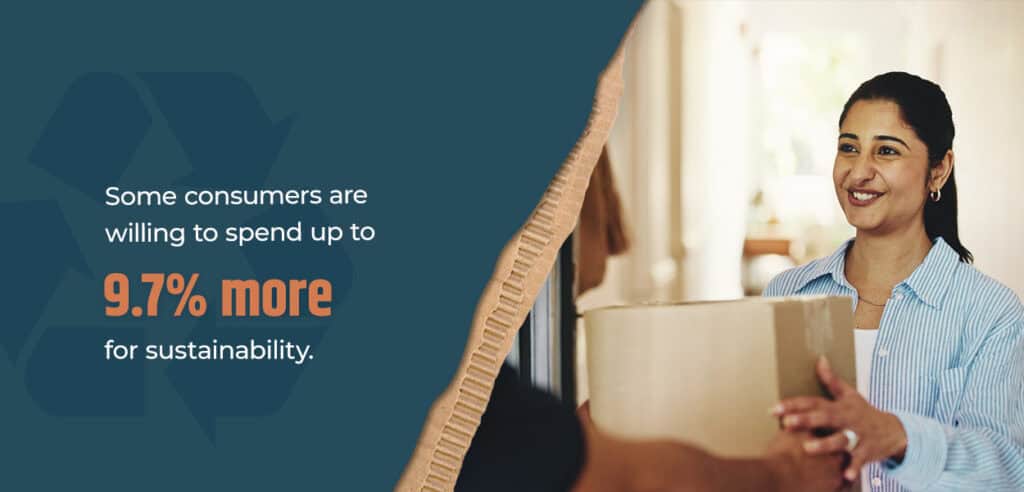
Consumer expectations have shifted. Sustainability has become part of the conversation between brands and their customers, shaping how products are evaluated alongside price, quality and convenience. Some consumers are willing to spend up to 9.7% more for sustainability.
Many large retailers and corporations have integrated sustainability assessments into their supplier relationships, using scorecards and ratings that evaluate environmental performance, packaging materials and carbon footprint alongside traditional metrics. Suppliers with stronger sustainability performance may be more likely to be selected as vendors, and companies increasingly use these assessments to reduce risk, build supply chain resilience and meet stakeholder expectations.
Documented emissions reductions provide the proof points these stakeholders demand. Transparency around your carbon footprint builds credibility and a competitive advantage in eco-conscious markets.
Several U.S. states have enacted comprehensive packaging Extended Producer Responsibility (EPR) legislation, with more states moving in the same direction. These programs generally involve reporting requirements, fees tied to material type and recyclability and consequences for noncompliance. Companies that have already optimized their packaging are generally better positioned to manage compliance costs than those starting from scratch under deadline pressure.
Brands that take visible action on sustainability often stand out in the minds of their customers, and a documented commitment to reducing your carbon footprint can help build trust over time. This reputational value extends beyond individual transactions. Companies that lead on environmental responsibility may be better positioned to find more opportunities for visibility, whether through industry conversations, partner recognition or organic word of mouth.
The investment in measurement and reduction becomes a marketing asset that differentiates your brand in crowded markets. Having credible, verified packaging footprint data can position you to win contracts over competitors as sustainability documentation becomes a more common part of B2B procurement conversations and RFP processes.

Bolt Boxes makes it easy to put these strategies into action. We specialize in custom-sized corrugated boxes engineered to fit your products perfectly, eliminating excess material and reducing transportation emissions. Our boxes contain 60–95% post-consumer recycled content and offer 100% recyclability — mono-material solutions that align with your environmental goals without compromising protection or brand presentation.
With over 60 years of experience in structural design and an on-time delivery rate of over 99%, we combine sustainability with the speed and reliability your business demands. Ready to reduce your packaging carbon footprint? Contact Bolt Boxes today to design a lower-impact packaging solution.

