


Packaging optimization is a powerful and often overlooked way to cut e-commerce shipping costs, sometimes yielding better savings than carrier negotiations.
Minor changes, from choosing precisely sized boxes to engineering a perfect fit, can save you money on every shipment. When you multiply those improvements across hundreds or thousands of orders, the impact on your bottom line will become impossible to ignore.
In this guide, you’ll learn proven, concrete strategies to make your packaging work harder, reducing costs, improving operational efficiency and delivering an outstanding customer experience.
Several factors influence the relationship between packaging optimization and shipping costs, giving you multiple levers to control your spending.
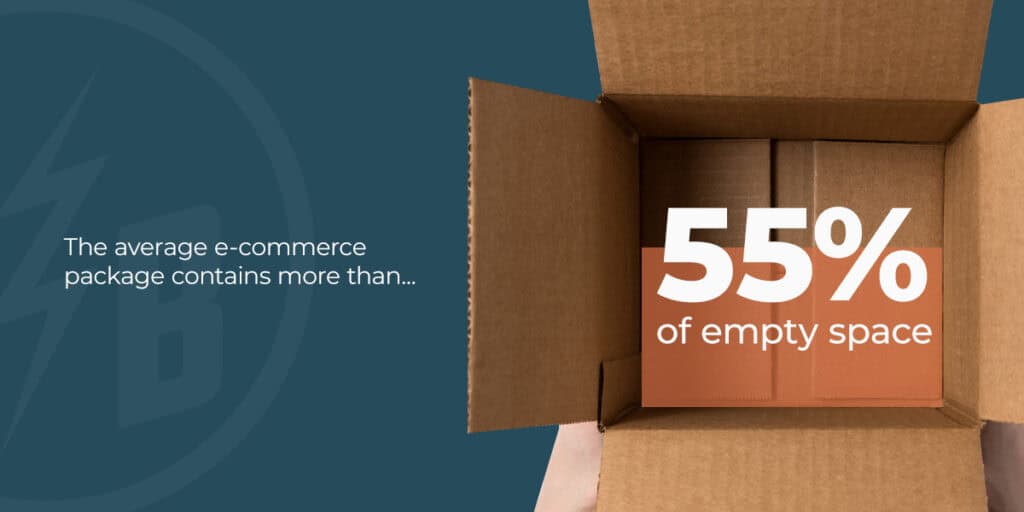
The average e-commerce package contains more than 55% of empty space. In other words, you spend over half your shipping costs on moving air. While this might seem minor on a single order, it represents a significant, avoidable drain on your margins when multiplied across your entire shipping strategy.
Working with an expert packaging partner can mitigate this lost space through smarter design and custom-built boxes. Instead of cutting corners to save shipping costs, Bolt Boxes designs packages more purposefully, so every inch offers value.
Behind every shipping charge is a calculation. Since carriers use a pricing model that accounts for space and mass, you’ll pay for how heavy your package is and how much room it takes up inside the truck.
Dimensional weight is a formula that converts a package’s size into a billable weight. Instead of charging solely by scale weight, carriers calculate the space your package occupies in their network. All packages contribute proportionally under this model, even if they don’t weigh much.
In practice, this means a large, light package can cost more to ship than a smaller, heavier one. The impact on e-commerce brands is noticeable. Many products are relatively lightweight, but shipping them in the inappropriate boxes can incur avoidable charges.
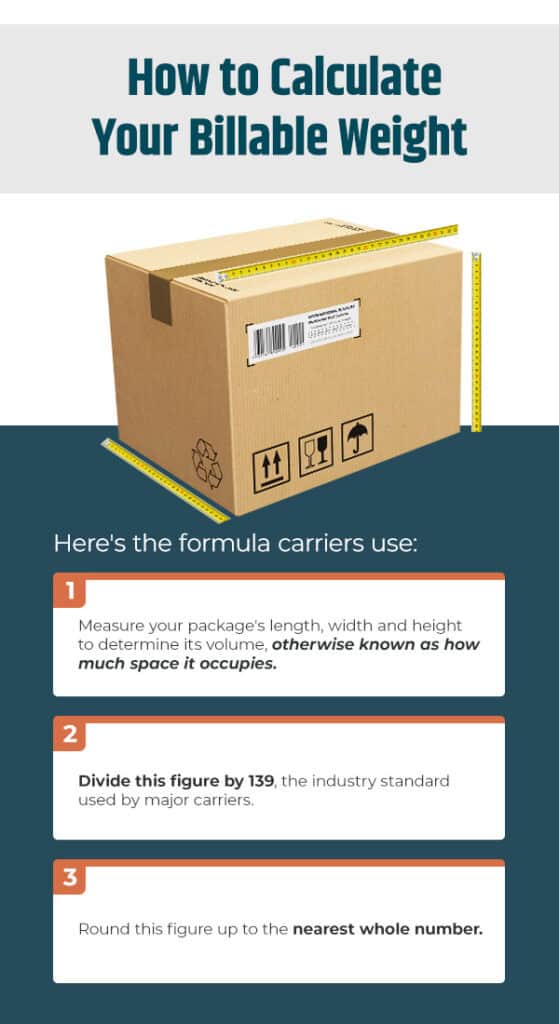
Here’s the formula carriers use.
Remember, carriers always charge for whichever is higher — the actual package weight or the DIM weight.
Let’s put this into practice. Picture a box that is 12 x 10 x 8 inches. Multiplying these figures equals 960, and 960 divided by 139 equals 6.9. Next, rounding 6.9 to the nearest whole number shows that your carrier will charge you to ship 7 pounds.
But how can this formula reduce shipping costs? If you shrink your box’s dimensions to 10 x 9 x 7 and do the math again, you’ll see the shipping charge drop to 5 pounds. Now, picture how saving 2 pounds of shipping weight per box can add up across your bottom line.
Here’s a side-by-side comparison showing how having the correctly sized box can drastically reduce spending.
| The dim formula | |||||
|---|---|---|---|---|---|
| Packaging Type | Dimensions | Volume | DIM weight (volume divided by 139) | Actual Weight | Billable Weight |
| Standard box | 14x12x6 inches | 1,008 cubic inches | 7.25, rounded up to 8 | 2 pounds | 8 pounds |
| Right-sized box | 10x8x4 | 320 | 2.3, rounded up to 3 | 2 pounds | 3 pounds |
| The difference | — | Minus 688 | Minus 5 | — | 62.5% saving |
Now, consider a small but fragile item, such as a candle in a glass jar. The product is only 3.5 x 3.5 x 4 inches and weighs 1.5 pounds. The challenge here is protection.
Many businesses would place the candle in a standard 8 x 8 x 8 stock box and fill the empty space with bubble wrap. While this feels safe, the extra void fill increases the package’s dimensions and, therefore, its billable weight. The dimensions of this box would equal 512 cubic inches. Divided by 139, this rounds up to 4 pounds, all of which you’ll pay for in shipping.
Packaging engineers take a more strategic route, creating a customized 4 x 4 x 5 box that perfectly fits the candle. Dividing the 80-cubic-inch dimensions by 139 gives you 0.57, which rounds up to 1 pound for DIM weight. The product’s actual weight is 1.5 pounds, which the carrier will round up to 2 pounds for billing purposes. This example shows how choosing a smaller box can save you 50% on your shipping costs without compromising protection.
While UPS and FedEx use 139 as their standard divisor, USPS operates slightly differently. Dimensional pricing typically applies to packages over one cubic foot, or 1,728 cubic inches. However, note that USPS often bases pricing for smaller shipments on a product’s actual weight.
Because UPS and FedEx use a lower divisor, they generate a higher dimensional weight for the same package size. In other words, packaging efficiency is paramount when shipping with these carriers.
Understanding dimensional weight packaging is the foundation. The next step is applying targeted strategies that reduce unnecessary volume while still delivering top-quality product protection.
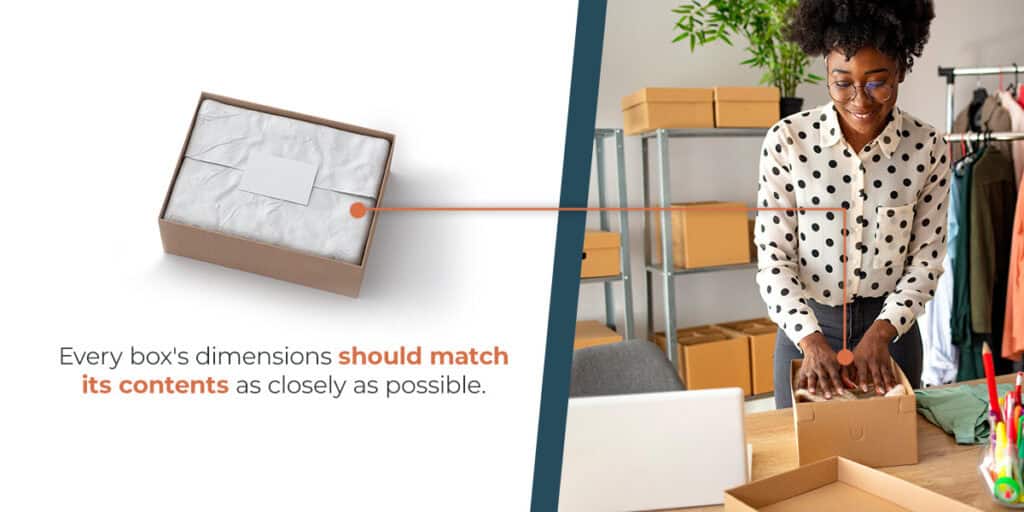
Many companies lose revenue by using boxes that are far larger than necessary. Ideally, every box’s dimensions should match its contents as closely as possible. The goal of right-sizing isn’t to force your product into a too-small package. Instead, you want to reduce excess internal space, lower dimensional weight and improve packaging efficiency.
Start by measuring your top-selling SKUs’ actual product sizes, then compare those to your current packaging. Use the DIM weight formula to calculate the billable weight. From here, develop a best-fit carton range — typically, three to five box sizes that cover most of your order profiles.
This simple step can make a noticeable difference in cost savings by reducing carrier charges and packing labor. Trimming pack-out time by even 30 seconds per order can save over 40 labor hours for every 5,000 shipments.
Once you’ve calculated your dimensions and DIM weight, shift your focus to material choice, which influences durability, weight and how tightly you can pack products. Most boxes consist of corrugated board, a material engineered to balance strength and flexibility, providing protection without unnecessary bulk or added weight.
The shipping and packaging industry uses two critical measurements to evaluate corrugated board performance.
When properly matched to the product, flute selection becomes a vital factor in controlling structural performance and package size.
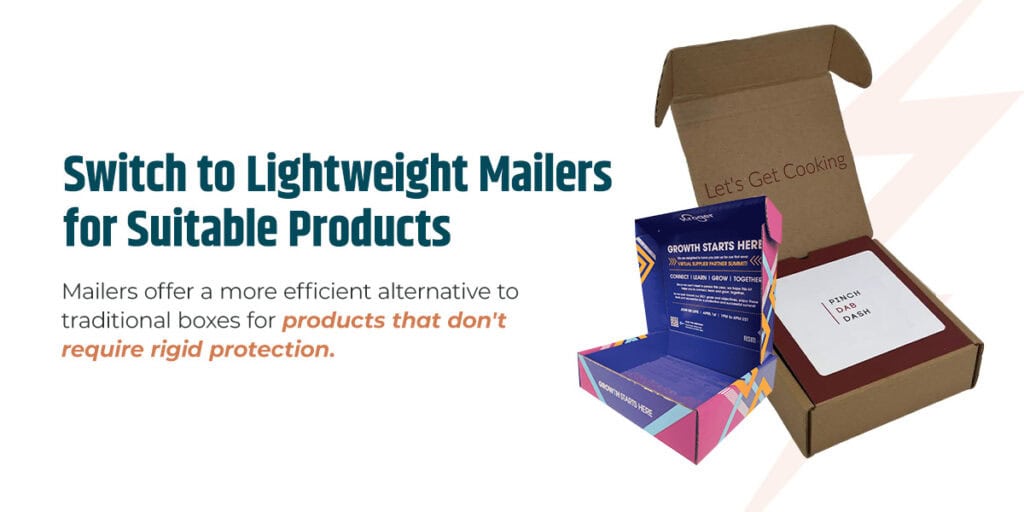
Mailers offer a more efficient alternative to traditional boxes for products that don’t require rigid protection. They conform to the product’s shape, reducing unused space and lowering dimensions and weight.
Mailer options include poly mailers for lightweight, sturdy items, padded mailers for added protection and paper mailers for a more structured, recyclable alternative.
Because they minimize excess volume, lightweight mailers can reduce DIM charges across many shipments, especially for light products. In addition to cost savings, mailers also improve fulfillment speed.
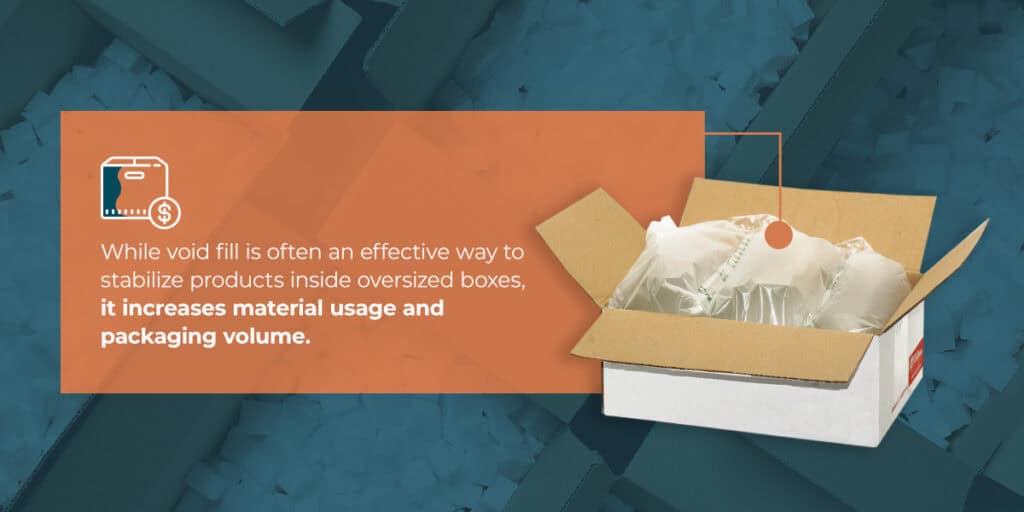
While void fill is often an effective way to stabilize products inside oversized boxes, it increases material usage and packaging volume. Engineered inserts provide a more elegant solution.
By designing the internal structure around the product, they:
Applied consistently, these strategies reshape how your packaging performs in transit, unlocking cost-reducing efficiencies that impact your bottom line.
Cost efficiency is an immediate benefit of packaging optimization, but it’s not the only one. Packaging designed with performance in mind simultaneously supports multiple areas of your operation, creating value that extends beyond shipping.
U.S. e-commerce businesses had an average return rate of 16.9% in 2024, underscoring the need to prevent unnecessary returns due to product damage.
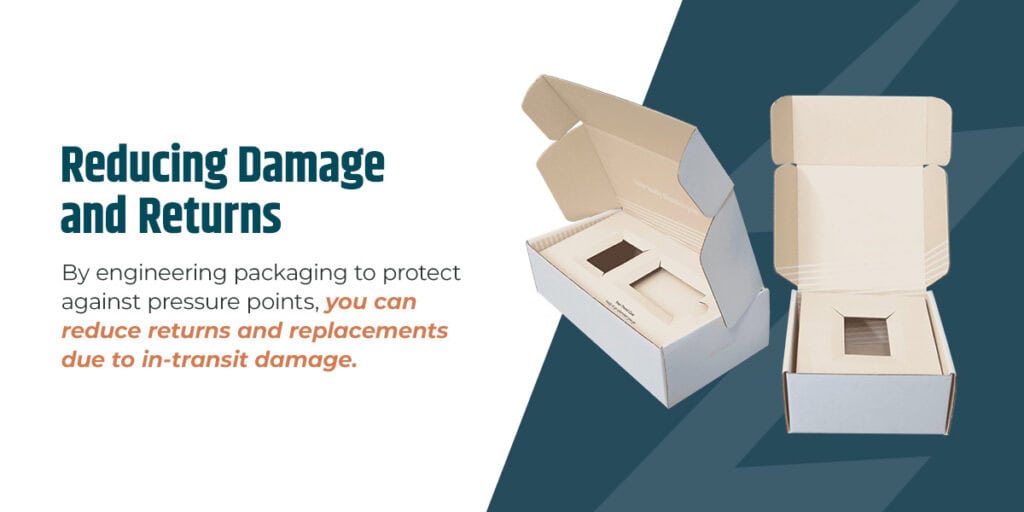
By engineering packaging to protect against pressure points, you can reduce returns and replacements due to in-transit damage, therefore reducing waste, lowering costs and building customer loyalty.
Packaging often creates the first impression customers have of your brand. An oversized box stuffed with excessive filler can feel inefficient and cause dissatisfaction. By contrast, a well-fitted, thoughtfully designed package feels intentional and considered, reflecting the quality of the goods inside.
But the unboxing experience goes beyond how well your products fit. According to research, creative and relevant packaging has a powerful impact on a customer’s purchase intentions. Satisfied consumers are more likely to tell other people. Many e-commerce buyers post unboxing moments on social media, turning your packaging into a powerful marketing tool.
Focus on the sensory and emotional details to create a memorable experience, strengthen brand recognition, encourage repeat purchases and drive long-term customer value.
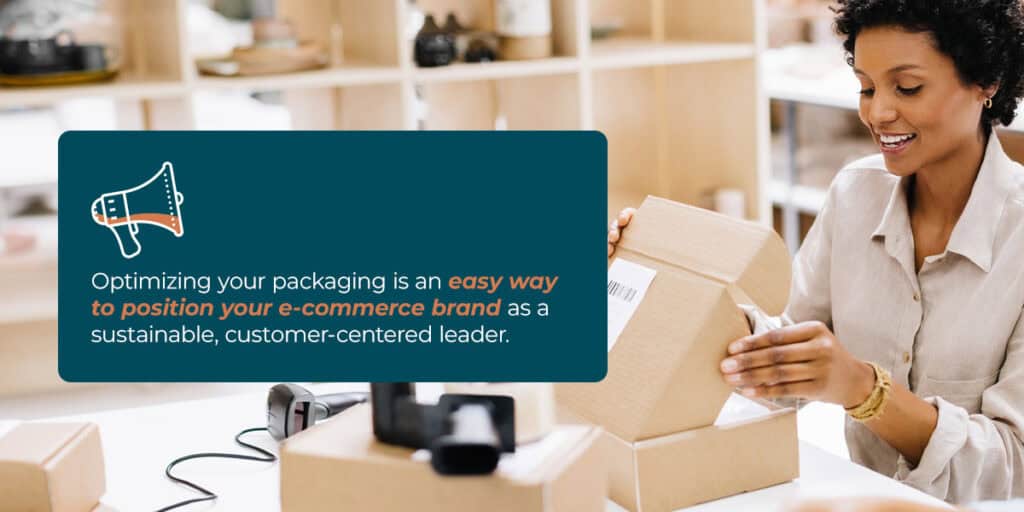
With over half of shoppers being reluctant to buy from brands that aren’t sustainable, having an eco-friendly shipping method is essential. Optimizing your packaging is an easy way to position your e-commerce brand as a sustainable, customer-centered leader.
Turning your understanding of how packaging impacts shipping costs into consistent, measurable improvements requires a structured approach. Working with a dedicated packaging partner is invaluable.
Instead of focusing on individual box sizes, a structured approach looks at:
From there, package design can align with the realities of how your products move through the supply chain.
Subtle factors can influence package performance, from how shippers handle packages at different points in transit to how materials respond under varying conditions. These variables aren’t always obvious during initial design, but can add up over time.
An experienced packaging partner will point out these overlooked details early in the process. By identifying potential pressure points before they arise, they can ensure your packaging performs consistently across different scenarios, supporting more predictable outcomes for you and your customers.
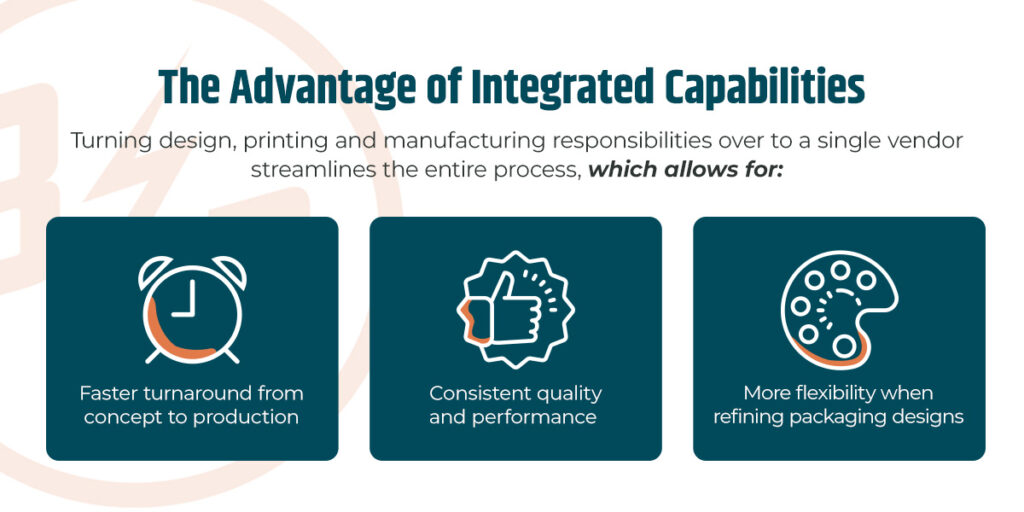
Turning design, printing and manufacturing responsibilities over to a single vendor streamlines the entire process, which allows for:
Integrated capabilities also make it easier to move from testing to implementation, reducing delays.
Once you understand the variables, you can start applying them across your entire operation. A packaging partner can translate insights and measurements into practical, scalable solutions that align with your products, processes and shipping requirements. From refining box dimensions to testing different material and structural combinations, this approach ensures your packaging performs as you intended before you roll it out at scale.
These FAQs break down the most common questions e‑commerce brands ask so you can ship smarter, avoid surprises and keep your customers happy.
The simplest way to reduce e-commerce shipping costs is to concentrate on package size, structure and material. By aligning box dimensions more closely with your products, selecting appropriate materials and reducing unused internal space, you can lower DIM weight and improve pricing across all your packaging.
For most e-commerce businesses, it’s DIM weight. Optimized packaging solutions often yield significant cost savings in e-commerce shipping.
Prioritize packaging that offers adequate protection. Your goal is to reduce unnecessary space while maintaining the structural integrity required for safe transit.
Not necessarily. In most cases, a best-fit carton range can cover your order profiles. Use custom-designed packaging or inserts to protect fragile or high-value items.
Your approach changes when you start thinking of packaging as a performance driver. As the world’s fastest box manufacturer, Bolt Boxes draws on decades of advanced packaging engineering expertise to help businesses reduce shipping costs, improve consistency and scale their operations.
From initial concept to production, we build every stage around performance. That includes access to advanced design capabilities, a wide range of materials and print options and a streamlined process that supports faster turnaround times.
Explore our Box Builder tool to get started, or contact our expert team for tailored guidance today.


